Introduction
This is arguably the most valuable free module in Kaapra Campus. Most trading content teaches how to win; almost none teaches how not to blow up — which is exactly what determines whether you last. Risk management is what lets you survive the losses that even the best traders take, and keep trading long enough to improve. Educational only, not investment advice.
1. Why Risk Management Matters Most
Most beginners focus entirely on being 'right' — finding the winning trade. But even excellent traders are wrong a large share of the time. What actually determines long-term survival isn't how often you win; it's how much you lose when you're wrong.
A trader who is right 40% of the time but controls losses tightly can be profitable. A trader who is right 70% of the time but lets losses run unchecked can still go broke. That single idea reframes everything else in this module.
2. Position Sizing Basics
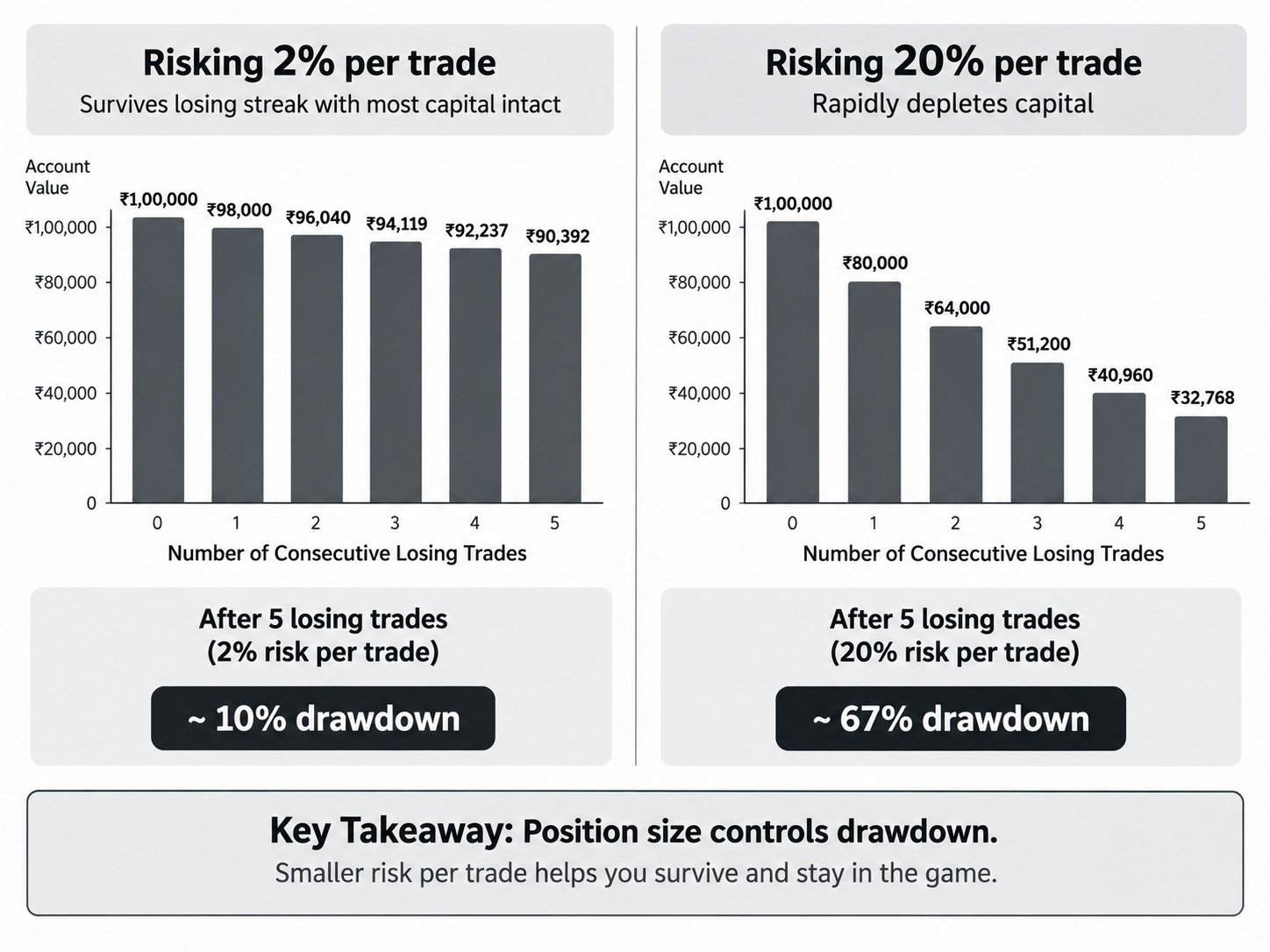
Position sizing means deciding how much capital to put into any single trade — and it matters more than most beginners realise. A common starting guideline is to risk only a small, fixed percentage of your total capital (often 1-2%) on any one trade.
The effect is powerful: a string of losses shrinks your capital gradually rather than catastrophically, leaving you with enough to recover and keep learning. Sizing is the difference between a survivable losing streak and a wiped-out account.
3. Stop-Loss — Your Safety Net
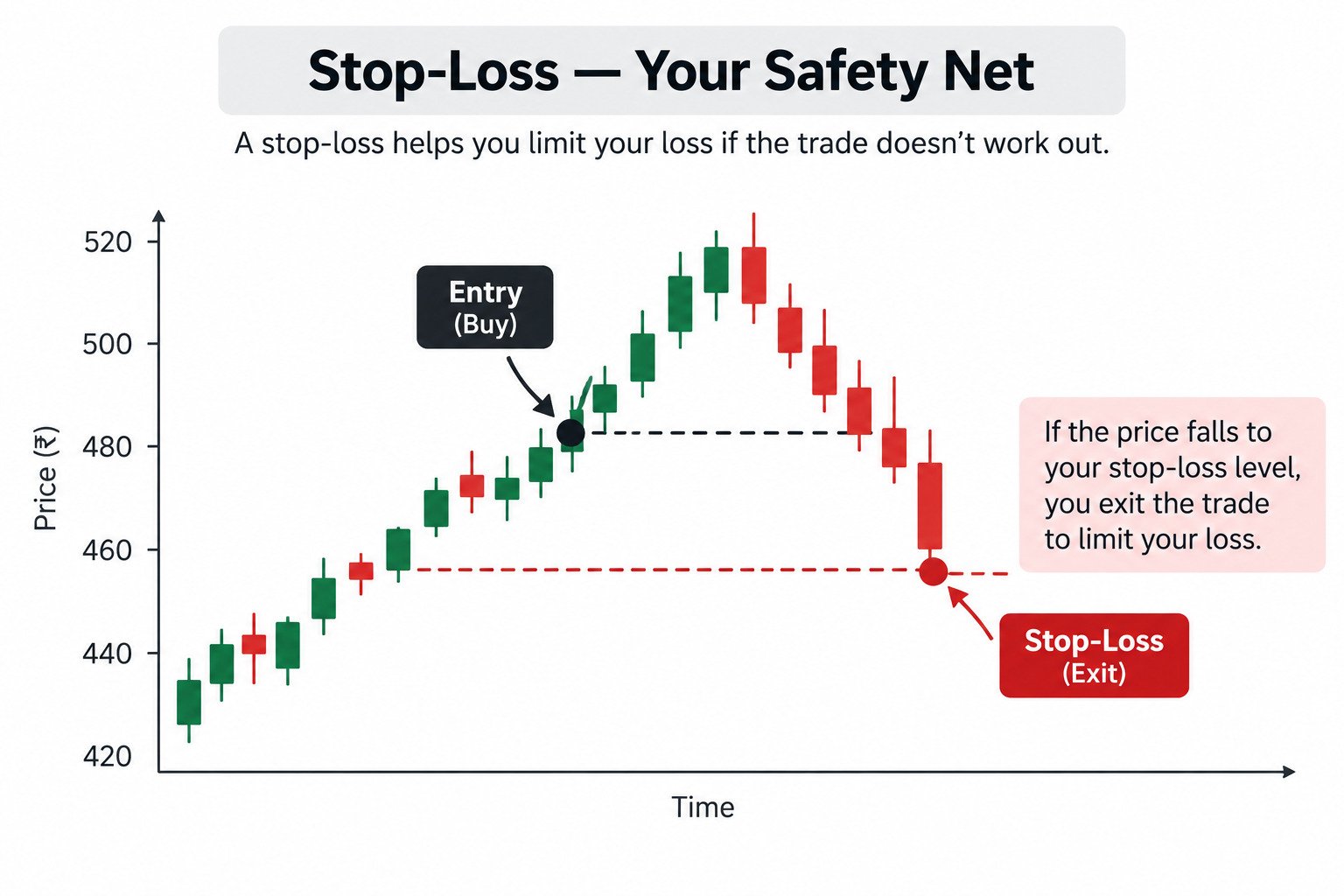
A stop-loss is a predetermined price at which you exit a losing trade — decided before you enter, not in the heat of the moment when emotion takes over. It caps how much a single trade can cost you.
A good stop-loss is placed based on chart structure — for example, just below a support level that, if broken, means your reason for the trade no longer holds — not on an arbitrary rupee amount you're emotionally comfortable losing.
4. Risk-Reward Ratio
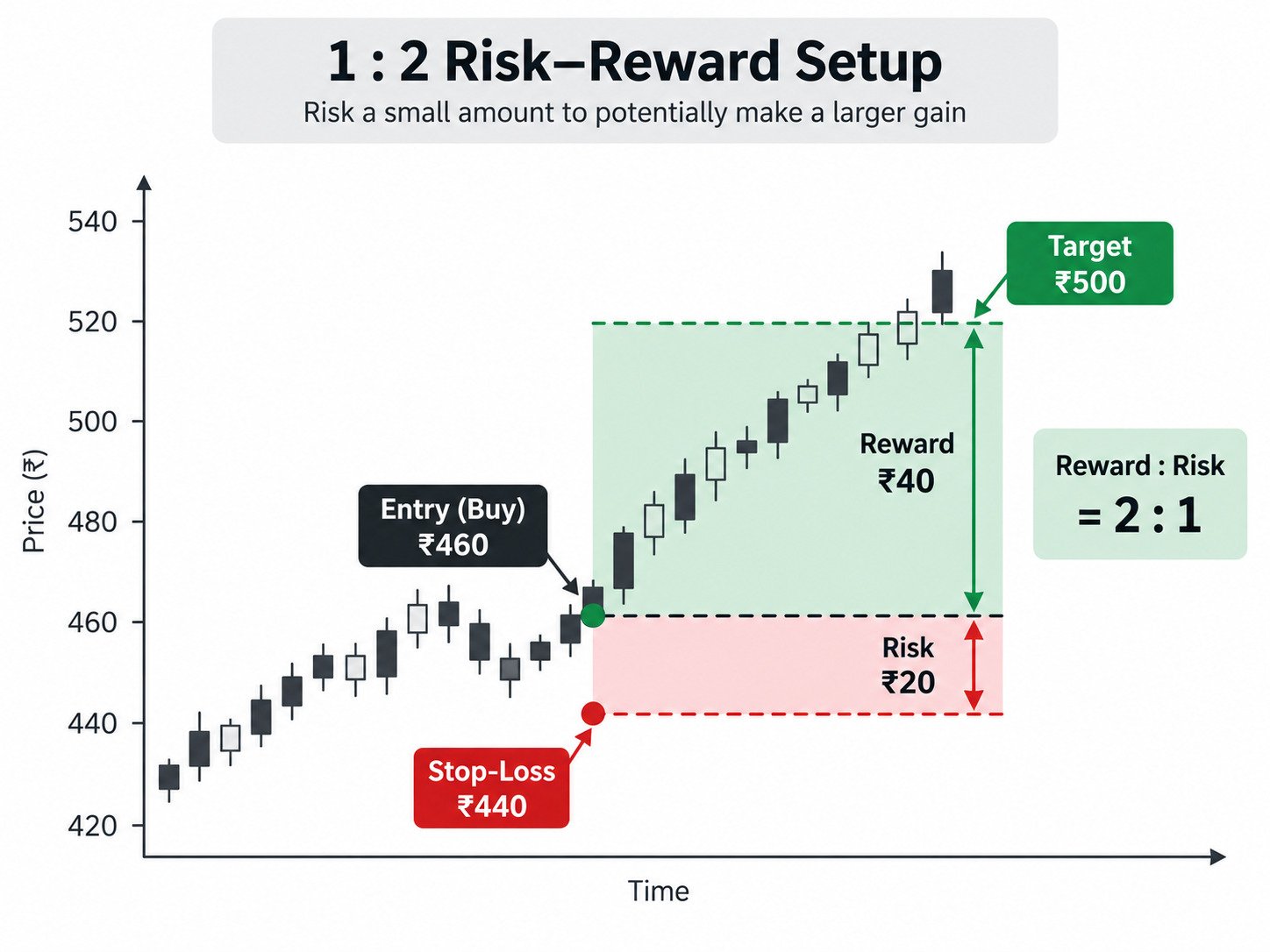
Risk-reward compares how much you stand to lose if a trade fails against how much you stand to gain if it works. A common target is aiming for at least twice the potential reward relative to the risk taken (a 1:2 ratio).
Here's why it's powerful: with a good risk-reward ratio, you can be wrong more often than right and still come out ahead overall. It shifts the goal from 'win every trade' to 'make sure winners are bigger than losers' — a far more achievable and durable approach.
5. Diversification & Avoiding Ruin
Diversification means spreading capital across different stocks or sectors rather than concentrating it all in one place, so no single bad outcome can do serious damage to your overall capital.
It isn't about avoiding losses altogether — some positions will always lose. It's about ensuring no single loss can hurt the whole. Combined with position sizing and stop-losses, this is what protects you from the one mistake that ends a trading journey.
This is educational content only, not investment advice.